Sean's story
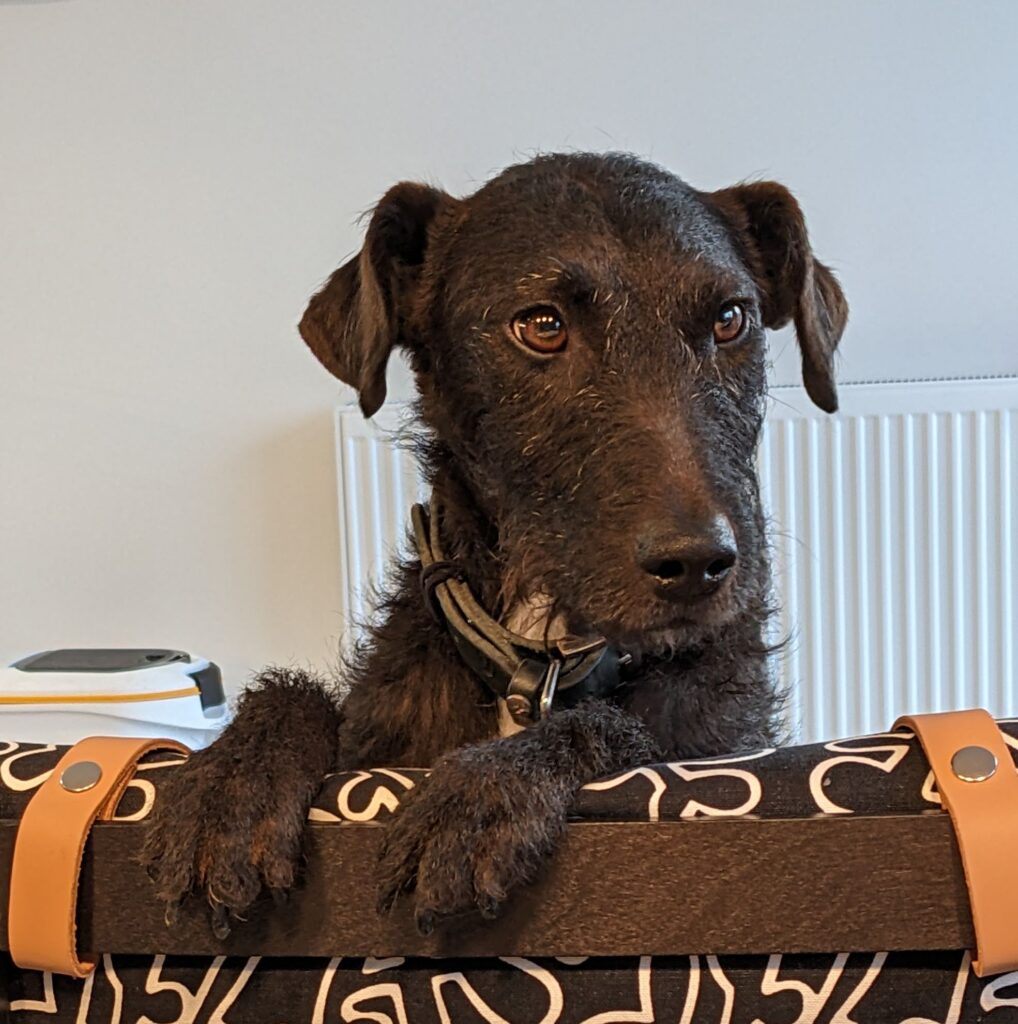
Dogs Trust's underdog Axel (aka "rude boy")
We adopted Sean (whose rescue name was Axel) in January 2024 from Dogs Trust Ireland. When we brought him home, we quickly realised that we needed to do A LOT of work to make his life and our life comfortable and stress-free. This is the story of how we have done it (so far).
The beginning
Why have we chosen this particular dog? Mind you, he was not looking half as cute in his shelter photos as he turned out to be.
The reasons were mostly pragmatic. I needed a medium-sized dog: I was the only person in the household who had any dog ownership experience (30 years ago), so it was unwise to get a big and possibly hard-to-manage dog, and all other family members firmly voted against a small dog. I needed a dog with a minimum amount of shedding, because of our history of allergies, so wire-haired terriers seemed to be the best option (also, my first dog was a schnauzer, so I was imprinted to love a square-ish dog with a beard). I needed a dog who could stay at home alone for more than a couple of hours, because we all work full time (though I work from home half of the week). This narrowed down the search to DogsTrust (who were ready to give us a week’s trial to see if we were allergic) and to this guy, who by that time has lived in Dogs Trust’s kennels for almost a year and officially qualified as an Underdog (6 month+ in rescue’s care) .
Sean, as many rescue dogs, had an unknown past. Dogs Trust pulled him from one of the regional pounds in spring 2023. His date of birth was listed as March 8th, 2016, but I do not know where this information came from and how precise it was. His rescue intake vet record is from 07/03/2023 at the vet clinic in Listowel, Co.Kerry. That record stated that he was 7 years, 3 months, but then the date of birth 08/03/2016 emerged in the subsequent documents. In any case, according to the records, he was around 8 years old when we met him, but we still find it hard to believe it. Now, in the ripe age of 10, he has great teeth, is active and agile, and has very few grey hair. We are regularly asked if he is a puppy:)
His breed was listed as Patterdale cross, but this was an educated guess. Later we have done a DNA test, but since Patterdales are not a recognised breed (they are only recognised by local British kennel clubs, and DNA-testing labs rely on AKC classification), we received back the mix of about 10 different terriers, which sounds about right for a Patterdale. Mixed in there were 10% of gundogs – mostly german wirehaired pointers, with some setters. This addition probably explains why Sean is almost twice bigger than a “pure” Patterdale should be. In any case, he definitely has strong Patterdale traits – independent thinking, athleticism, and high tolerance to pain. Mixing in pointers only made him bigger and stronger, (and possibly a bit more sensitive – I have heard pointers are very sensitive souls) and turbocharged his predatory drive.
What the hell is "reactivity"?
The rescue warned us that this dog wasn’t doing great with other dogs (hence the nickname “Rude Boy”), but they believed that it was just frustration from not being able to play with them and general stress (all dogs are stressed in shelter environment and can have a short fuse when it comes to another dog’s awkward social manners). We, however, quickly found out that the problem was much bigger. Sean had a major fear reactivity towards other dogs – in other words, they stressed him out so much that continuous exposure to them led to a full-scale meltdown. Unfortunately, we also found out that every second house in our neighbourhood had at least one dog, so wherever and whenever you go, you were bound to meet some dogs. And when that happened, Sean would bark and lunge and thrash around – and while we were lucky that he was just 14 kg at the time, these were 14kg of pure lean muscle (and very dense bone), which, turbocharged by extreme anxiety, could bring down a fully grown person. First time we went away for 3 days and left him with the youngest member of the family (20 years old and 6 feet tall), he managed to do just that – and oh my did I get an earful about blooded knees, torn jeans, and the impossible assignment of looking after my crazy dog. One good thing – even in the middle of a complete panic attack, Sean would never redirect to humans. He could bite an approaching dog (and have done it once), but he would never bite a person, which is, on average, quite a non-typical behaviour for terriers, who tend to be quick to respond to any stress with their teeth. After the reactive episode Sean would try to get away from the scary thing as soon as possible, which meant that he would be pulling like a truck for 20-30 minutes, dragging us behind him – not a pleasant walk with a dog one might have imagined.
Other people might have decided that walking such a difficult dog is too stressful and confined him to exercising and doing his business in the backyard. Aside from the ethics of doing such a thing (which might be OK for some dogs and downright abuse for others), this was never an option for us. We have a small suburban garden and it was absolutely clear that no amount of time spent there playing fetch, training and doing scentwork can replace for Sean the benefit of going outside, where the amount of new information was many times higher. It was not as much about physical exercise, it was about a particular kind of mental stimulation. He was a working terrier bred to roam the rough terrain for hours in search of small furry prey. He needed three walks a day. It was non-negotiable. If not walked, he started bouncing off the walls, barking and generally pestering us relentlessly. So, life was very stressful three times a day, and I needed to take action urgently.
The only other dog whom I knew well – our family’s Schnauzer – had been a very sweet, highly social girl, who was good with people, other dogs and even cats (she has been raised by our very firm and no-nonsense male cat, who had been quick to lay the law with her and maintained the upper hand for his entire life). I had no idea what “reactivity” was and, in general, knew almost nothing about dog behaviour. But facing a dog who screamed at the sight of another dog, I went online (as you do these days) and a short search brought me to Reddit, where someone (thank you, unknown person!) pointed towards Grisha Stewart and her BAT setups. I immediately bought her book and finally things started to make sense to me. Still, it is unadvisable to deal with a serious behavioural issue on your own, so I went back to DogsTrust and they gave me some contacts of trainers. We started working with Jennifer Flynn from Pawtential, who was super helpful – but probably not in a way that many unexperienced people imagine a trainer to be helpful. I learned that trainers do not actually train your dog (surprise!) – they train you to train your dog. A good trainer with a behavioural expertise will also explain to you why the behaviour is happening and how you can change the environment to address the problem.
The first important insight that Jennifer brought was that Sean’s behaviour was not a frustration from not being able to play with other dogs – it was fear. He was barking and lunging to scare the dogs away from his personal space (which at that stage was huge). That seemingly simple idea was actually counter-intuitive: why would a dog actively pull me towards the thing that they are very scared of?? One would expect a scared dog to tuck his tail, hide behind the owner, or run in another direction. Some dogs do that, but many don’t, and terriers in general are unlikely to run away from a challenge – they have been bred to be fearless and rush at the prey (who might be biting and snarling and being as scary as possible) to sort it out before it had an opportunity to do so first. In Sean’s case, if he was allowed to approach a dog (which we still did sometimes at the start), this immediately turned into a confrontational encounter, with jumping on another dog’s head, body-slamming, nipping the legs – all along with a very tense body language, tail high, completely fixated on a dog and taking no pauses or changing roles (both of which are signs of play behaviour). In dogs’ terms, his behaviour was very rude (earning him his Dogs Trust nickname) and most dogs immediately corrected him or ran away – both outcomes would send him into a frenzy of barking. It is possible that initially for Sean there was a play intent, but due to his poor social skills (most likely resulting from a lack of proper socialisation early in his life), repeated attempts to play resulted in negative outcomes – dogs telling him off, stressed humans on both sides, being dragged away from an exciting thing – and he quickly learned that dogs=stress. From now on, the stressful thing needed to stay the hell away from him, and he was ready to run across an entire football field to explain to a passing dog that it needed to disappear from his horizon. A huge overreaction – but that is exactly what reactivity is – an inadequate reaction to normal stressors of everyday life.
so, what was the final diagnosis?
One of the most difficult things with Sean was that, at the start, he had so many inter-connected issues that it was hard to decide what to prioritise (especially given that I was learning the entirely new subject of dog behaviour, health and training from scratch at the same time). I had to tackle these issues simultaneously, and it was often hard to identify which of the interventions worked – this was not a clean experimental design one would hope for! More or less, the biggest challenges were:
1. Reactivity, as described above. This seemed to be the biggest issue, if only because it was so loud, inconvenient, left Sean clearly stressed and unhappy, and interfered with his most basic need to be outside.
2. Predatory drive – strictly speaking, this is a feature, rather than a bug. Working terriers are supposed to be chasing and biting anything that looks like a prey. And not just biting – killing. Which in why, in the ideal world, working terriers are trained to be highly obedient and are living in the environments where their natural drive can be safely channeled into keeping farms free of rats and rabbits. Here, in the real world, we were dealing with an 8 year old working terrier who had zero obedience training and was trying to live as a pet in a busy urban suburb, where neighbours’ cats roam outside, people think rabbits and hedgehogs are cute, and hunting is a complete no-no. Was it an ideal environment for this dog? No. Did he have any other options? Also no. I strongly suspect that if we had not adopted him, he would still be living in kennels, slowly going mental. Dogs Trust valiantly tried to find him a quiet rural home, but to no avail – who, in their right mind, would want a dog whose approach to any animal except people (and these days, other dogs) is “bite hard first, ask questions later”? He had jumped up (multiple times) to try and bite a huge highland cow – ten time bigger than him, with very large horns. No fear at all. This means that we have to manage him very carefully when outside – something that most owners of “normal” dogs probably cannot even imagine (given that many of them are not even capable of noticing when their dog has done their business, so consumed they are by their phone screens and their podcasts).
Three issues were the consequence of Sean’s predatory drive. First, he had zero recall – and even now, 2.5 years later, I would never trust him off leash in a public space. He wears a collar and a harness that he cannot escape, and a GPS tracker on his collar – in case the leash unclips or he manages to slip through the door. You might think this is excessive and paranoid. It is not. This dog slipped through the door twice and both times he immediatelly went on to harrass the dogs and cats in the neighbourhood. Both times we got told off by angry neighbours for not having our dangerous dog under control. These were not the kinds of experiences we are keen to repeat. Sean also once managed to wriggle out of a collar, harness and sweater when he was rushed by two off-leash dogs in the middle of a park and my partner lifted him into the airjail. Thankfully, he had not run away, but proceeded to circle the dogs and bark at them, until my partner managed to catch him – yet, it was very stressful (add winter cold and darkness to the picture). In sum, this dog tends to keep us on our toes.
Second, he has lightning-speed reaction and zero bite inhibition when it comes to real prey. Unfortunately, we had two incidents when our neighbours’ free-roaming cats decided to start a fight with Sean instead of running away from him – a very stupid decision indeed. Maybe some dogs can be scared away by hissing and by clawed paws scratching their nose, but Sean does not even notice such minor inconveniences. Both cats have been seriously injured, because it was VERY hard to pry them out of Sean’s jaws (25% bullterrier DNA clearly all went into those jaw muscles). Luckily, both cats recovered, but we paid a hefty vet bill, had super unpleasant conversations with cats’ owners, and my partner will probably always have the scars from his valiant efforts to save the cats’ lives. More recently, improved biodiversity in the area has brought hedgehogs into the neighbourhood. Unfortunately, I learned about this when my dog has dived into a bush and emerged with a hedgehog in his jaws. Was Sean bothered by all the sharp spines in his mouth? Not at all. After I managed to get the first hedgehog from his grip (I spare you the details of this painful affair), literally two days later he caught another one in the long grass. So, when some time later he caught a rabbit, I did not even try to stop him finishing the job (which, in fairness, was quick and completely bloodless). Remarkably, once the rabbit was no more, Sean dropped it, then calmly took it and went home, where he immediately lost any interest in it. His job was done and he was deeply satisfied. This showed to me that, despite what my cat-loving neighbours* might think, he was not being bloodthirsty for the pleasure of it, he was just following his genetic programming.
Third, his constant sniffing out the prey often turns into scavenging, with most organic substances being fair game. Frustratingly for me, Sean is rather unpredictable in his tastes, so he might pass a potential target nine times and then, before I can blink an eye, consume something that looks to me exactly like the ones that he had no interest in. This means it is hard to prevent scavenging, because you either try to stop him sniffing anything – which gets him very stressed, or give up and let him eat whatever he finds. The latter would be my preferred option if only he did not have such a sensitive stomach. The state of his digestive system was another big issue that we had to address head on.
3. Being “sick to the stomach” (literally). When we adopted Sean, the rescue said that he was healthy. I learned that, in rescue world, this pretty much means that a dog does not have any major life-threatening illnesses or medical conditions that require urgent interventions. Thankfully, Sean did not have any of those, but he was having constant stomach problems since the very first day. We got used to him waking us up multple times per night to go into the garden and to picking up poo so liquid it required several bags. After many urgent visits to the vet and endless tinkering with his diet, I finally came to the vet (about 6 months in) and asked for a radical solution. We got a prescription for hydrolised protein food and within 2 days the problem has disappeared. It was like magic – I could not believe my eyes. Turned out, Sean was allergic to chicken. Ironically, any food for senior dogs and any food for sensitive stomachs is chicken-based, so the more we tried to make him better, the worse he would get.
*I also love cats, but they should be kept indoors, where they are safe. Cats roaming outdoors without owners’ supervision are a public nuisance, because they kill birds, use flower beds as litter boxes and pick fights with each other and other animals. I also disapprove of the double standard where dogs going after cats is considered completely inappropriate (“dog owners should control their vicious animals!”) but cats going after birds is considered a normal “natural behaviour” (“that is just who they are”).
first priority - management
It was clear that changing Sean’s behaviour was going to be a long process (we thought – months, but actually it was more like years). Just a caveat – not every behavioural change takes years, but in Sean’s case many variables were stacked against him. His reactivity was quite severe. He was 8 years old and has likely rehearsed the reactive behaviour for a long time, which made a strong neural pathway in his brain “see dog => freak out”. He was a Patterdale -highly driven, excitable, non-biddable breed, who was not wired to seek guidance or protection from humans, but instead used to solving problems on his own. He spent a year in kennels and had a high level of general anxiety from this experience (and who knows what experiences before that). So, while we worked on teaching Sean how to make better choices, we needed to make sure that everyone is safe.
First of all, we needed to make sure that we don’t lose him. Very quickly we found out that when he is thrashing around madly at the sight of a dog, he can easily wriggle out of his collar and harness. Ouch. With the time, after trying different gear, we came up with the solution: martingale collar (his neck is thicker than his head, similar to that of sighthounds, so he heeded a collar that he cannot back out of), three-point harness with the belly strap and GPS tracker.
Second, we were concerned that his poor social skills would end up starting a fight, and that he might bite another dog, with all the unpleasant consequences of this. This kind of happened 6 months after we got Sean. He was walked by a dogwalker, and while she turned away for a second to dispose of a poop bag, a small off-leash dog ran up to Sean (clearly ignoring all his loud “go away” signals). Sean, being on short leash and having nowhere to go to escape the threat, bit the small dog through the ear (perhaps making sure that the dog actually uses her freaking ears in the future when she is told “I do not want you in my space”). Imagine the scene: a small innocent-looking dog is screaming, because Sean has clenched his teeth on its ear and would not let go (he is not shaking the dog, he is just holding it), a panicked dog-walker is struggling to unclench Sean’s mighty jaws, and the bitten dog’s owner is looking at this impassively. Finally, the dog’s owner came over and helped free his bleeding dog, after which he just put it on leash and left silently. At least he had no complaints, but everyone was very shaken. Needless to say, that was the last time Sean was walked by a dog walker – not because I blamed her for the incident, but because I realised that Sean is not ready for walks with people who do not have a deep insight into his behaviour and the ways to manage it.
With the help of our trainer, we started muzzle training almost immediately, but it is not something that can (or should!) happen overnight. Very slowly and carefully, after several months of small progressive steps, I fully muzzle trained Sean. That does not mean that he is always wearing a muzzle now, but he wears it often, whenever needed, and has no issues with it. These days he is not wearing it to avoid altercations with dogs, but to protect free-roaming cats and hedgehogs in our neighborhood. Now, we do not leave the house without a muzzle and put it on Sean in the places of known high cat/hedgehog activity. I also carry an equivalent of a bitestick, to open Sean’s mouth when he grips a prey.
Why am I going into those unpleasant details about bite incidents? Because these are the risks of having a dog with a high predatory drive (I have so much anger about the practice of breeding hunting dogs who struggle to live as pets in normal homes and then disposing of them when they are no longer useful, as many hunters do – and do not even get me started on the plight of sighthounds) and this is why management strategies, such as muzzle training, escape-proof gear and keeping a dog on leash, are so important.
a stressed dog cannot learn
I cannot emphasize enough how stressful shelter environments are for dogs (#adoptdontshop). Smells, barking, confinement to a kennel for most of the day, close proximity to potentially scary dogs, lack of agency – all of this is very, very bad for a dog’s nervous system. Dogs Trust is one of the best rescues in Ireland and they take very good care of their dogs, but even they could not provide what Sean needed – 2-3 hours of nature walks per day, extensive mental enrichment and a quiet place where he had a sense of security from other dogs (it does not matter that de facto he was always safe, as long as he could see, hear and smell the dogs close by, he was stressed). Sean coped with kennel stress by being hyperactive, so when we were taking him home, the rescue said that “he was always on the go” and they did not know whether he would be able to settle at home. He was a kind of “ADHD dog” (spoiler alert – he is not actually ADHD, he just needed to decompress and learn that life is predictable and his needs are always going to be met). After almost a year spent in kennels, Sean was a nervous wreck.
Luckily, he won a lottery with us:) We have a very calm, adult-only house with a small enclosed garden. We speak in quiet voices and do not even play music (other than TV in the evening). We have guests maybe 5-6 times a year, and none of them have small children. In the first days I would spend a lot of time just sitting with Sean on the floor or on the stairs (he would crawl into my lap immediately), lightly scratching his neck or just resting my hand on his back, talking in low soothing voice to him. We did not set up a crate for him (the idea of putting him in confinement again after a year in a kennel just seemed wrong), but he found a guest bathroom upstairs that nobody was using and slept there for hours on the bathroom mat. That was the darkest and quietest place in the house and we left him alone there (in fairness, we would not call and bother him at all in the early days, waiting for him to come to us – which he gladly did, following me like a shadow most of the time). That safe place earned Sean a nickname “Prince of Darkness”, because all one could see when he slept in that bathroom was the light reflected by his eyes and an occasional light tuft of fur on his chest, where he has a lightning-shaped patch of white.
There is a 3-3-3 rule of thumb in rescue, but it can take much more than 3 months for a dog to settle in. For Sean, it took about 10 months to fully decompress. How did I know it finally happened? Because he started wondering freely across the park following the scent trails, instead of keeping to the paths (first it was just one path that was considered safe, then it became possible to steer him to other paths but he still would not venture into an unchartered lawn territory). From that moment on, his progress in learning has increased rapidly. Yes, he has learned a lot of things in the first 10 months with us, but most of them were in relation to behaviours in the house. His house manners, by the way, have become excellent very quickly – he is perfectly toilet trained, has zero destructive behaviours, does not counter surf, never tried to get into the trash… the list goes on. But outside, in the presence of triggers, he was still hypervigilant and his progress in the right direction was painfully slow. He did well in carefully orchestrated BAT setups with the trainer, but I could not replicate this success in real life setting, with dogs appearing suddenly and moving too fast and unpredictable (or even worse – barking!).
Except just giving him time, two main things turned out to be key in reducing the general level of stress and getting Sean into the state of mind in which he was capable of learning how to make good choices. The fiirst was giving his nervous system a break from triggers. Jennifer immediately tried to implement a full decompression protocol with us, which normally included not exposing the reactive dog to triggers for a couple of weeks. We rebelled and reduced this to no walks during the day for about 7 days. That was hell. It was February, wet and cold, our garden turned into a mucky swamp and even Sean was not keen to spend time there. He wanted to go outside badly, but not into the garden. No amount of games inside could satisfy him, and I was supposed to work from home as well. That was the lesson that even well-intentioned, evidence-based protocols do not work for every dog. At the end we compromised on walking Sean very early in the morning (starting from 4:30am and gradually moving towards later time of 5:30-6:00am as his resilience increased), very late in the evening (around 10pm) and a having a short walk around noon in the places where few people lingered with their dogs (I would not venture into the park during daytime until the second year). The context is important here – we live in the place where lots of people start walking their dogs early (6-6:30am) and where attitude to leash laws is more then relaxed – meaning that there are always plenty of off-leash dogs in the parks and only some of them have decent recall. If this schedule sounds tough – that’s because it was, but we have done it (I got used to going back to sleep for an hour after the early walk). Now I can walk Sean at any time of the day – if my work allows, our morning walk starts at relaxed 9am. I also learned all back roads, quiet cul-de-sacs, grassy patches in industrial estates and other places where normal dog owners would not want to go with their dog. The standard advice of going into a wilder part of a park/beach has not really worked for us – yes, there are fewer dogs there, but those that are there, 100% would be running off leash, because their owners think that surely in this wild spot they would not meet anybody. And in Sean’s mental maths an off-leash dog was like +150 danger points. He would rather prefer to sniff every blade of dusty grass between two warehouses if he could do it without spaniels and labradors running up to say hi. Later (about 14 months after we adopted Sean) we also added Reconcile (dog version of prozac) medication to help his overwrought nervous system become less reactive to stimuli, allow it to learn coping skills and gradually realise that the world is not so scary. Reconcile has not changed behaviour overnight, but over time it took the edge off Sean’s reactions and supported his learning.
The second major thing was to address the physical discomfort. Until we sorted out what was wrong with his digestion, he was living with a constant low-level stomach discomfort – no wonder he was unsettled and grumpy! As soon as we moved him to the prescription food, his mood and his ability to relax has improved substantially. Later on we consulted with wonderful Dr Claire Corridan from Great Expectations and on her advice did further medical tests which revealed some hip and knee problems. Once we added pain medication, we have seen further progress towards calmer and less reactive dog, both in the house and outside.
training with a small "t"
As a person who has never done any dog training before we got Sean, I was unaware what a minefield this was, and how bitterly people on the internet fought about “the right way” to train a dog. Understandably, I was confused and unsure what to do, when most of the “official” advice assumed that I was training a young puppy of some highly biddable breed – a golden retriever, a lab or maybe, if I like a challenge, a showline cocker spaniel. Instead, I had an 8 year-old excitable working terrier with low ability to self-regulate, strength and speed of a small torpedo, poor bite inhibition, and zero knowledge of any, even basic, commands. It remains a mystery to me how one could have a dog for many years and do not teach him to sit or have even rudimentary recall – that should have been so inconvenient for the owner!
Anyway, I had to abandon the official literature, read the books on dog behaviour, and, with some help from the trainer, experiment my way towards the training approach that worked for me and my dog. I have to start by saying that I am firmly in the positive reinforcement training camp. Yes, you can train with fear and violence, and get quick results. It is even possible that your dog will not hate you for this, because dogs are adaptable and have great capacity for love (many children also keep loving their abusive parents, which does not justify abusive methods). But – even if I had been ethically OK with using pain and fear to get obedience (which I was not) – my particular dog was a very poor candidate for this approach. Working terriers are independent dogs with very high tolerance of pain, and Sean was already anxious about the world and scared of many things. To make sure that, at my command, Sean abandons his own agenda, suppresses his emotional and predatory impulses and “does obedience”, I would have had to cause him A LOT of pain, to get through his adrenalin-flooded nervious system to his thinking brain. “Leash correction” (jerking the leash) or “pop on the nose” or shouting at him would have had zero effect. I would have had to beat the crap out of that dog to make him listen to me. Imagine what this would have done to his already pessimistic outlook on the world, caused by his life history, and how detrimental this would have been for our not-yet-fully-established relationship. This was never an option for me. Yes, sometimes I have to cause him discomfort – when I give him a bath or make him swallow bitter anti-nausea medicine, but I would never use discomfort as a training tool.
Since Sean was so anxious in the first months, he was not a good candidate for traditional training sessions (Training with a capital “T”). First of all, because of his reactivity, I could not take him to any kind of dog training class, social walk or any environment where other dogs were present. Second, his attention span was very short, so multiple repetitions of the same command would not work for him – he would do something 2-3 times and then lose interest or get overexcited (just give me the treats, woman!). This meant that standard protocols for training basic “manners” just weren’t effective – or worked at 20% capacity. Outside of the house he was hypervigilant, constantly scanning the environment for dogs, always straining at the end of the leash, and would not take any treats, so training even the behaviours recommended by our trainer (like “treat scatter in the grass when he sees a dog” or “mark and move”) was almost impossible. Very hard to train a dog who pays no attention to you at all. The videos of “dogs in training” returning to check on their owners after a light pressure on the lead has been applied looked like a bad joke – my dog would not return to me even if I pulled with full force, in fact, the more you pulled, the harder he would resist, leaning in the opposite direction, sitting, lying down and generally turning into a stone statue.
It does not mean that none of the training advice has been useful – the best ones were “reward the behaviour that you like, ignore the one you don’t” and “reduce the opportunities to rehearse undesirable behaviour” (well, the second one is, strictly speaking, management, not training, but let’s not be pedantic about terminology). I did a lot of ignoring, rewarding and managing until Sean learned how we expected him to behave. I ignored his barking for food when we ate at the table or when I cooked – and he learned fairly quickly that this behaviour does not bring desirable results, so he stopped. I rewarded him for sitting down quietly when we exit the house to go for a walk – and now he does it automatically (and I keep rewarding it), so we don’t have a dog who rushes madly into the street and possibly collides with the neighbours’ dogs. I put semi-transparent film on the glass door pane and restricted access to the windows looking into the street until he calmed down enough not to bark at the passing dogs. Now he only barks at cats and delivery vans, but this is allowed (a terrier has to have some sort of a job, and being a stranger alarm is actually a useful one for us). I taught him to sit by asking to do it every time he wanted something – for the door in the garden to be opened, for the food to be provided, for the ball to be thrown, – so every type of reward was used, not just food. I would constantly praise him whenever he behaved calmly, even when I have not asked him to do it, just to send him a signal that what he is doing is right (anxious dogs need to build their confidence).
Training outside was more of a challenge, because he was so anxious that only a tiny bit of his brain space was available, but ultimately, the same principles applied. I eventually taught him not to pull on the leash by simply rooting myself on the spot whenever he started to yank my shoulder out of its joint. He would hit the end of the leash, sit, then lie down, then stand again, throw his entire weight against the leash trying to move me forward. All of this – with the leash attached to his collar (do not believe people who say that harnesses cause pulling): Patterdales have chest and neck muscles of steel! I would hold my ground, sometimes even pulling him several steps back as a penalty for a partularly wild jerking of a leash. After several minutes of cooling down, I would allow him to move forward. If he started to pull again madly, I would stop again. If he gave me at least a bit of slack on the leash, he was allowed to keep going (you have to have realistic goals, a dog cannot move from rushing full pelt to calmly walking by your side straight away). Gradually, he developed very decent leash manners (unless he is spooked by something or clocked a running prey), but it was a slow and frustrating process, which had nothing to do with the training to walk at heel.
Overall, training Sean involved a ton of patience, constant close observation of his body language (the main way the dogs communicate) and operating in terms of “behaviours” rather than “commands” – in other words, training with a small “t”. Allie Bender and Emily Strong describe this approach (which I kinda constructed for myself out of books, scientific analysis, my pedagogical experience, and trial-and-error) much better in their book and podcast “Enrichment for the real world“. They are some of my dog training/behaviour heroes – I love what they are doing and fully agree with their philosophy.
What does all this training of basic manners have to do specifically with reactivity? I think, there are two main connections:
– the more Sean learned the rules of living with us, what we wanted and not wanted him to do, the more predictable his environment became and the more secure he felt. Dogs, especially nervious and highly sensitive individuals, thrive on predictability and stable routine. Predictability liberates them from the burden of guessing what will come next and worrying whether this is going to be a good thing or a bad thing. In addition, building a solid history of positive reinforcement teaches the dog not to worry that they are going to be punished even for something like an accident in the house or half of pizza completely accidentally falling from the table into the dog’s mouth. It is remarkable, by the way, that despite everything that the proponents of “dogs have to face the consequences of their bad behaviour otherwise they will be unruly” approach claim, I have never punished Sean for chewing the furniture, accidents in the house, or stealing food from the table – and yet, he is now 100% housetrained, never chews anything in the house and does not counter surf at all. Reducing the mental load of worrying about daily routine and interactions frees up space in the dog’s brain that can now be used to teach skills that help the dog better manage scary situations that provoke reactivity.
– training any behaviour is a process of communication, so the more your do it, the better you and your dog understand each other. You start to understand the tiny nuances of body language and behaviour, which helps to prevent and manage reactive episodes. The dog learns that listening to you is a profitable activity, which also scratches the itch for problem-solving that smart independent dog breeds have in abundance. They start to give you the most precious commodity – their attention.
the magical double "A": attention and agency
9-10 months after we adopted Sean, we hit a frustrating plateau in his reactivity training progress. He has improved, but not sufficiently, and it was still difficult to manage his daily walks. We still walked at ungodly hours, and he still often had a short fuse if a dog looked or barked at him, and he would 100% lose his mind if a dog ran up to him. Our trainer gave us a plan and more or less signed off on our case. I knew exactly what skills I needed to teach, but could not get much progress.
After a lot of reading and reflection, I figured out that it did not work because I could not reward good behaviour promptly when my dog was always 3 meters ahead of me and not coming back when called (zero recall, remember?). By the time I managed to attract Sean’s attention to the treat, it was too late and he did not know what he was rewarded for. In addition, I was having problems with offering Sean sufficiently high value treats – he was on a strict hydrolised diet because of his sensitive stomach, and absolutely all of shop-bought treats (and also such training staples as cheese and sausage) disagreed with his digestion. He would work for his kibble in low-stress environment, but would literally spit it out if I offered it outside of the house.
Eventually, I decided to focus on building recall from the end of the leash – something that other dogs, apparently, do automatically, but which my dog had absolutely no inclination to do in any circumstances. I started in the quietest residential street at 5am in the morning, to minimise the amount of distractions and would do it 2-3 times per walk, using dried bread (which he loves and his stomach tolerates) as a treat. I would just stop and wait for Sean to figure out that he has to come back, and I would not move until he did (because recall is not optional). Since I was doing it in the middle of the night under people’s windows, I would not use verbal commands, but would use the “touch” hand signal (open palm as a target for nose touch) and very soft “tsk” sound to attract Sean’s attention. Since those early days of 5am trainings, I learned to rely on hand signals and speak to Sean in very low voice rather than shout commands at him – he does understand some words, but saying them louder does not make them more convincing, he has excellent hearing, so you might as well whisper them and keep the calm energy in the interaction.
Within weeks, Sean understood what is required and began coming back. I would also reward any attempt at check-in (looking back at me) and any eye contact, even a fleeting one. Before, I tried to teach “look at me” command, which worked fine at home, but did not work outside. Clearly, capturing existing behaviour (what is called “shaping” by trainers) worked much better for Sean than learning the commands. He has to figure it out on his own – then it sticks. And once he figures out what is expected, he needs to repeat this enough times to build a strong neural pathway in his brain, so consistency is super important. I trained relentlessly, every day, at every walk. This does not mean that you do long and boring drills – I would not be able to commit to this, especially at 5am on a cold and wet day. Instead, I did a little bit, literally, 1-2 minute worth – but every time we were out, just to remind Sean what this is all about.
Bolstered by this success, I increased the intensity and complexity – asking for recall more frequently and in busier places. It was not 100%, but it was definitely getting better. He started paying attention to me! About a year later, when Sean was doing million times better relative to these early days of recall training, I came across a book “When Pigs Fly” which FINALLY contained training advice that aligned with my experience. I was almost crying happy tears when I was reading it, because I have never felt so seen and understood. The author, who traines bullteriers and other non-biddable, independent-minded breeds, explains that, with dogs which are not hard-wired to work with you, you need to pay for attention and make it worth their while to listen to you, because, unlike herding dogs, terriers are not getting warm and fuzzy feeling of fulfilling their innate purpose when they do what their human says. For terriers, whatever human asks them to do is a side quest, a distraction from their main purpose of independently tracking and hunting prey. These neural pathways are strong and you need to respect them. Trying to train a terrier like a golden retriever leads to frustration and the labeling of terriers as stubborn and untrainable, and overall – not good family dogs. I disagree with this. Terriers are very good dogs, but they are different and have to be trained and managed appropriately (perhaps not every family can do that, but then not every family can manage a golden retriever with their resource guarding and bottomless appetites for all things edible and not).
Anyway, I was paying for attention now, and suddenly the training began to work exactly as it should have. I started with counter-conditioning – every time Sean met a dog, regardless of his behaviour, he was getting a high value treat (roast beef became the solution, because bread was not sufficiently high value). There were no conditions: dog=amazing treat, and nothing else, except dogs, could bring about this bounty. For several months, I would carry two treat pouches: one with beef, just for those meetings with dogs, and another with dried bread for continuing recall and attention training. The progress was very rapid – Sean started looking at me whenever he saw a dog and coming back to me for as many treats as were needed to keep him busy while the dog moved away. The more he has done that, the less he was rehearsing his reactive behaviour, and gradually his ratio of “good choices-to-violence” has become much, much better. Suddenly, “treat scatter”, “mark and move”, “observing dogs from safe distance with reinforcement for staying calm” – all these things started to work as they were meant to. We were given good advice from the very start, but without breed-specific understanding it did not work, which is why I had to troubleshoot it myself. In fairness, our trainer had some experience with Patterdales, but I guess it takes living with one to truly understand how their mind works and how different it is from human-oriented breeds.
Another cornerstone of our success was taking Sean’s agency seriously. Giving dogs as much agency as safely possible is one of the key ways to give them enriched life (see Allie Bender and Emily Strong’s book), but I feel that it is particularly important for independent-minded breeds, because we remove more agency from them when we ask them to be a family pet when we do from dogs that are specifically bred to be home companions. Dogs like Sean have not been bred to live a quiet suburban life among cars, kids on scooters, lazy indoor-outdoor cats and hundreds of small dogs. They were bred to roam the rough rural terrain, hunt vermin, get in fights with other farm dogs, cause hilarity and mischief, and come home in the evening to curl in front of the fire next to their humans, looking cute and innocent. For further details – see “Three Men in a Boat” by Jerome K. Jerome, whose description of the fox-terrier Montmorency can be easily applied to any terrier:) But, fiction aside, working terriers do need opportunities to make their own choices to be fulfilled and urban life severely restricts these opportunities. I feel sometimes that I am not able to give Sean what he needs (free-roaming in the nature), but DogsTrust tried to find him a rural home for 6 months and has not succeeded, so life with us is the best option this dog has.
How do you give agency to a dog who cannot be off-leash and has to be closely supervised around cats, footballs, and any animals and birds larger than a robin? For a start, by having a longer leash (around 4-5 m) and by giving him an opportunity to lead the way (as long as it is safe) on walks. He decides where he wants to go, and I will follow him into the long grass, zigzag across the lawns while he follows a scent, allow him to dive into bushes (keeping an eye for footballs and hedgehogs), and ask him at the crossroads “Where do you want to go?” If he stops, I wait for him to process information and to make a decision where he wants to go. If he slows down, I look for signs that he wants to turn back or cross the road. You can almost sense his relief when I figure out where he wanted to go and say “this way? sure, let’s go”. He gets extra spring in his step and is usually more relaxed and responsive after that. Alternatively, if you try to rush him or only steer him where you want to go, he will resist and get progressively more stressed.
Indoors, he decides where he wants to sleep (the only off-limit places are human beds) and has a bed in every room of the house. He has an on-demand access to the garden, and decides when he wants and does not want to go there. He can ask for attention and I will often give him at least several minutes (unless I am in a call), trying to figure out what he wants – to play, to train, or to do a food puzzle. As his reactivity improved, I also became more flexible about feeding and walking times, trying to give Sean opportunity to sleep if he wants to sleep, and to feed him when he leads me to his bowl (he has a fixed ration for the day, so this does not mean that I give him more food, but I might give it 15 minutes earlier if he really wants). When he barks at something outside, I come to him and ask in a genuinely curious voice “What is it? Ah, it’s a delivery van! Yes, how dare they come here bringing us parcels” – this shows Sean that he is not being ignored and he does not need to bark louder or longer for me to acknowledge that he is doing his job (it also possibly reassures him that there is nothing concerning outside that he needs to scare off with his barking). These are all small things, but they collectively contributed to a much more confident and calm dog, who – it seems – knows that he is being listened to and, in turn, is more likely to listen to me when I say “Sean, I am busy” (he will go to his bed and wait).
where are we now?
It’s been 2.5 years since we brought Sean home and found ourselves at the deep end of behavioural issues. To be fair, now I know that there are much, much worse behavioural problems than what we had: human-directed aggression, resource guarding, acute separation anxiety, and other such joys of maladaptive repertoirs. Our dog was “only” losing his mind when he saw a dog:) Yet, in our circumstances that was hard enough to live with. The good news is that the progress over time has been massive – Sean is almost unrecognizable now. Gone are the days of bouncing off the walls, pestering us every two hours, going into excited frenzy every time guests would come to the house, waking up at 5am ready to go for a walk. He is very chill at home and his activity levels, while still way higher than one would expect from a dog of his age, are more reasonable – two good long walks per day keep him happy. He likes a bit of training and requires some enrichment every day – shredding cardboard boxes, sniffing out treats around the garden, making good use of frozen kongs or long chews (whenever they do not upset his delicate GI system).
Most importantly, his reactivity has diminished very significantly, and while he still requires management around dogs, and dislikes in particular when dogs bark and stare at him, I do not remember when the last time he had a really strong reaction to a dog. Many dogs he passes in a neutral manner (yey!), with some others he seeks playful interactions. He still does not know how to meet and greet calmly, without initiating boisterous play (which does not work for many dogs, especially on leash), but we are working on it with the help of Kelly Hegarty from Purple Woofs. In general, there has been a shift in Sean’s perception of other dogs, and we more and more often see positive vibes. He loves confident and good-natured dogs bigger than him, who just come and sniff him without hesitation, and tolerate his puppy-like greetings of jumping on them. He also loves crazy large-breed puppies of 5-6 months old, who match his energy and level of social skill, and are not afraid of rough and tumble:) These days, I tend to give him a lot of agency in deciding on how to interact with a dog. Sometimes he wants to sit and watch them pass by (if there are multiple dogs, we can spend a long time waiting for all of them to pass) – that’s fine by me, anything is better than barking and lunging, and it also builds a library of positive experiences “the dog appeared and nothing bad happened to me”. Sometimes an off-leash dog runs up to us, and it is clear that there is a playful vibe – then I would give Sean the full length of the leash and allow him to chase and tackle the dog as much as possible, until they break apart naturally and the dog moves on. Unfortunately, I still cannot let him off leash and facilitate free play, but even short interactions make him happy – he might vocalise a bit in frustration as the play partner disappears, but he continues his walk in a calmer and more confident manner after such encounters. Ironically, I now love playful off-leash dogs with poor recall who were such a problem to us even a year ago. The biggest issue remains with small dogs, who tend to be scared of Sean’s tense body language (I guess, to them he looks like a slightly trigger-happy fella swaggering along the street looking for trouble), and as a result unable to either ignore him or tolerate his intensity, and with dogs who growl, bark and lunge at him – this really upsets him, and he reverts to defensive barking and nervous pulling. My personal pet peeves are dogs going ballistic behind the windows/gates and small dogs attached to buggies by a short leash – those are least likely to pass by without making a scene.
I have also managed to make some progress with his reaction to cats. At the start, he would literally scream at the sight of a cat if I would not allow him to chase it. Now we can meet a cat at close proximity (several meters) and initiate a cat-watching protocol: I ask Sean to sit and watch (if he is too close, he needs a gentle touch on his back to remind him to sit), feed him for a minute or so while he watches the cat, and then I ask him to move on and we continue our walk. He will never be safe around cats, and I will always have to carefully manage (leash and preferably muzzle) in the places of high cat density, but I do not have to drag him away anymore, and if a cat is asleep, he would not even be interested. Our biggest problem is with cats who do not have the fear of dogs and actively approach us, or those with fight reaction to a dog, who would initiate an altercation, putting themselves in close proximity of Sean’s teeth. I do not think any amount of training would make Sean ignore a cat who charges at him, growling and brandishing claws. The most stressful part of walking Sean in urban areas now is not expecting a dog to appear from around the corner (not a big deal anymore!), but expecting a cat to suddenly emerge from behind a garden wall or from under a parked car. Yes, I can, in theory, keep Sean muzzled all the time – the muzzle allows him to pant, bark and drink water, – but I do not want to. Muzzle does not allow him to eat grass, chew sticks, play with a ball – simple things that make his walks more enriching, which is particularly important in the absence of social component of dog play. Muzzle also makes it harder to deliver treats to him when I need his attention to be channeled away from a dog (it is not a simple distraction tactic, keeping Sean occupied by a search for treats makes him less interesting to other dogs who stop staring and pulling towards him and pass by peacefully). By the way, muzzle does not help against scavenging, because I had to cut the hole in the front to deliver treats during training, and now the same hole can be used to pick up stuff from the ground.
The issues of scavenging and no recall remain unresolved – probably forever. I kind of made peace with it, although I still envy people who can leave the house without a leash because their dog remains glued to their side, and I am still annoyed when I have to pull unspeakable things from Sean’s mouth again and again during the walk (which is why I always wear gloves). Yes, I know that this scavenging might be another reaction to his GI discomfort, but fixing that particular problem once and for all does not seem to be possible. Whatever people would tell you, no dog is perfect (same as no person is perfect). Sean is an absolute angel at home and is trying very hard to be good outside of it. And that’s good enough for me on most days.
Tried and tested gear
For the dog:
- Martingale collar – El Galgo Cotilla
- Harness – Ruffwear Flagline
- GPS tracker – Tractive
- Long leash – WilderWoofs
- Muzzle – a standard Baskerville basket muzzle
For the human:
- Gloves (because otherwise nervous dog+long line equals wrecked hands) – BMX gloves from Decathlon
- For wet weather walking – Muckboots
- Silicone treat pouch with magnetic lock – similar to this one